Philip
The King in YellowPhilip, the American narrator of The Demoiselle d'Ys, is defined by a journey from practical bewilderment to overwhelming attachment. Lost on the moors near Kerselec, he seeks only a route back to safety; after meeting Jeanne d'Ys, he discovers a love that seems to suspend ordinary time, only to lose her at the instant of physical danger and awakening. His narration makes the story both a romance of recognition and a tragedy of disappearance.
Identity and Introduction
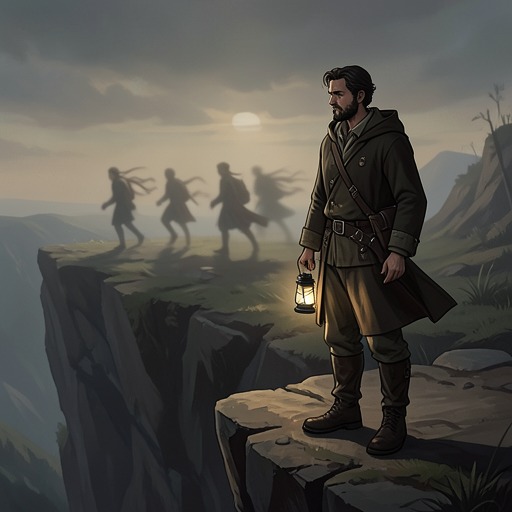
Philip introduces himself as an American unfamiliar with Finistère, visiting the region for his own amusement and shooting. His first important appearance is therefore marked by displacement: he is an outsider in a landscape whose distances and formations deceive him. What had seemed from Kerselec to be level grassland proves to contain valleys, gorse, heather, and enormous granite cliffs, and he realizes that he may have wandered far from Kerselec since daybreak.
His predicament is concrete rather than merely psychological. With evening approaching, he has lost the landmarks that might lead him to the ocean or back to Kerselec, and he considers spending the night on the windy moor. The setting strips away the confidence associated with travel and turns Philip into a dependent stranger, ready to accept help from someone whom the surrounding world has kept almost entirely apart from human society.
Encounter with Jeanne d'Ys
Philip's rescue begins when he discovers a falcon standing on a dead hare. The bird is not free: a leash encircles both talons, and a round piece of metal hangs from it like a sleigh-bell. Jeanne d'Ys enters the scene, lifts the falcon from its prey, places a hood over its head, and carries it on her gloved hand while fastening the hare to her girdle. Philip is initially so absorbed by this spectacle that he fails to recognize its practical importance. Only when she begins to leave does he recover his speech and ask for assistance.
Jeanne tells him that he could not reach Kerselec that night even with a guide, and she brings him to a fortified farm. The encounter reverses their apparent positions. Philip is the educated traveler from across the Atlantic, yet Jeanne possesses the local knowledge and the means of survival. At the same time, her musical, unfamiliar voice gives him the impression of something remembered without being understood, preparing the story's larger uncertainty about whether she belongs wholly to his present world.
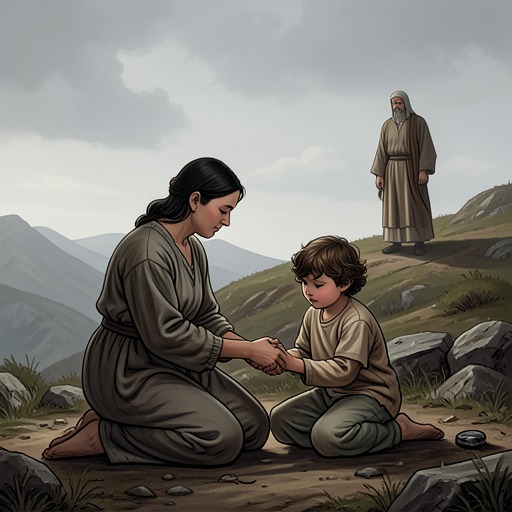
At the farm, Jeanne's isolation becomes clear. She is nineteen and has spent her life on the moorland with her nurse Pelagie, the piqueur Glemarec René, and four falconers: Raoul, Gaston, Hastur, and the Sieur Piriou Louis. Her parents are dead; she has never left the moorland and has scarcely seen any human being beyond the household. Her knowledge comes from old books, embroidery, spinning flax, falcons, and hounds, while Pelagie has taught her legends of Loup Garou and Jeanne la Flamme. Even the moorland carries a warning that a lost person may never return because the country is enchanted.
Love and Recognition
Philip's response to Jeanne changes with startling speed. While she breaks bread, he watches her hands and realizes that his unease is not illness or ordinary embarrassment but love. He understands that, from the moment he looked into her dark eyes on the moor, he had become willing to give his life to touch her. His confession is direct and self-accusing: he declares that he loves her despite believing himself unworthy of even her lightest thought and ashamed of turning her hospitality into an occasion for presumption.
The relationship nevertheless becomes reciprocal. Their silence communicates what ordinary speech cannot, and Philip interprets Jeanne's answering gaze as the recognition of a shared soul. He feels youth and joyous love coursing through him, while Jeanne appears awakened from a dream. They then exchange their names and speak of their lives, making the emotional bond more explicit through the simple act of mutual disclosure. The sequence follows the pattern of a romance in which meeting, rescue, confession, and reciprocal recognition occur in compressed succession, but it also makes the speed of attachment ominous: love arrives before either character can establish a stable world in which it might endure.
The natural world repeatedly intrudes upon their intimacy. When the falcons become agitated, Philip sees a grey serpent crossing the flat rock beside the stream. Jeanne identifies it as a couleuvre and treats the danger calmly. Later, after Jeanne has affirmed that she loves him, Philip embraces and kisses her, and the viper strikes his ankle. He tears it away and crushes its head, but the venom leaves him weak and numb. The animal is not merely decorative symbolism; it directly interrupts the lovers' fulfillment and converts the moment of mutual declaration into a struggle against death.
Disappearance and Ending
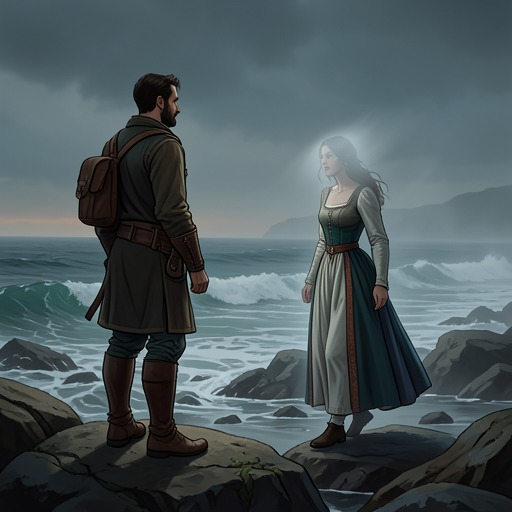
As Philip's sight fades, he sees Jeanne's face bending over him and feels her arms around his neck and her cheek against his lips. When he opens his eyes, however, she has vanished. The stream and flat rock remain, as does the crushed viper, but the hawks, blocks, garden, fruit trees, drawbridge, and walled court have disappeared. In their place stand ivy-covered ruins through which great trees have grown. A falcon rises from the treetops, circles upward, and vanishes into the clouds, offering a final visual trace of the world that has been taken from him.
Philip's bewilderment becomes grief when he calls Jeanne's name and falls before a crumbling shrine to Our Lady of Sorrows. The shrine gives the disappearance a religious and elegiac frame, while the ruined architecture makes the temporal rupture visible. His experience can be read as enchantment, vision, or an encounter with a vanished past, but the narrative does not restore Jeanne or provide Philip with a secure explanation. His decisive transformation is therefore not from ignorance to mastery but from isolation to love and then into bereavement.
Narrative Role and Significance
As narrator, Philip supplies the story's intimate evidentiary surface. He records practical details—the time of day, his weapon, the landscape, the falcon's equipment, the serpent's bite, and the ruins—alongside the inward shock of love. This combination encourages the reader to treat the impossible as something witnessed through precise physical observation. His credibility depends not on solving the mystery but on preserving the contrast between what he can describe and what he cannot explain.
Philip's encounter also establishes a romance pattern that the story finally overturns. He is lost, rescued, welcomed, and loved; the apparent movement is toward union, yet the very scene that confirms mutual devotion produces separation. The falcon, the hare, and the viper place human desire within a chain of pursuit, capture, and sudden violence. Philip survives the bite, but survival is not a return to happiness: he awakens in a world where the beloved's existence has become inseparable from ruins, legend, and uncertainty. His narrative significance lies in that unresolved aftermath, where the memory of love is more enduring than any proof that Jeanne d'Ys belonged to his time at all.